AI Image Verification
AI Image Verification vs Detection: Why It Matters
AI image verification is becoming more important as AI-generated images spread across websites, ads, blogs, and social media.
However, many people still confuse verification with detection. They are not the same thing. In fact, they solve two very different problems.
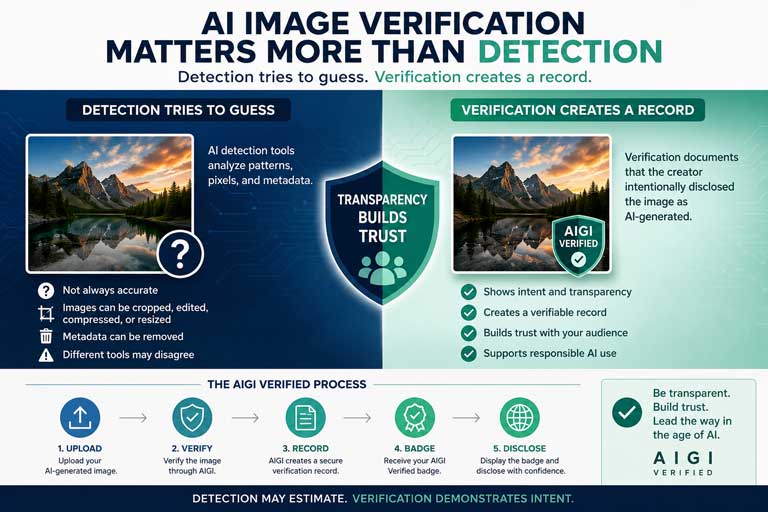
Detection tries to guess if an image was made with AI. Verification creates a record that shows the creator disclosed it.
That difference matters.
The Problem With AI Image Detection
AI image detection tools try to decide if an image was created by artificial intelligence. These tools may look at patterns, pixels, metadata, and other signals.
However, detection is not perfect.
Images change all the time. A creator may crop an image. A website may compress it. A social platform may remove metadata. Someone may resize it, edit it, or save it in another format.
As a result, detection tools can disagree.
One tool may say an image is likely AI-generated. Another tool may say the same image is human-made. Therefore, detection often becomes an educated guess.
That does not mean detection is useless. It can still help. However, it should not be the only answer.
What Is AI Image Verification?
AI image verification is different.
Instead of asking, “Can we guess if this image was made with AI?” verification asks a better question:
Did the creator clearly disclose that this image was AI-generated?
That is the real value.
Verification gives creators a way to show intent. It creates a record. It also gives viewers a simple way to understand that artificial intelligence played a role in creating the image.
In simple terms, detection looks backward. Verification starts with disclosure.
If you are new to the idea, you may also want to read What Is an AIGI Verified™ Image? for a broader overview of proof pages, QR codes, and verification records.
What We Learned Building AIGI
When we started building AIGI, we expected to find a clear standard for AI image disclosure.
Instead, we found confusion.
Many people were talking about AI detection. Some people were talking about watermarks. Others were talking about future laws. However, very few people were focused on helping creators prove that they chose to disclose their own AI-generated images.
That gap helped shape AIGI Verified.
We believe creators need a simple way to say, “Yes, this image was created with AI, and I am being transparent about it.”
That is why AIGI focuses on verification, not just detection.
Why AI Image Disclosure Builds Trust
Most people are not against AI images. In fact, many people enjoy them.
The problem starts when viewers feel misled.
A business may use an AI-generated product image. A blogger may use AI artwork. A marketing agency may create AI visuals for a campaign. In each case, the image may be useful and creative.
Still, audiences deserve clarity.
When creators disclose AI-generated images, they show honesty. They also reduce confusion. As a result, transparency can become a strength instead of a risk.
Trust is not built by hiding AI. Trust is built by being clear about it.
Why This Matters Now
AI disclosure is no longer just a future issue.
Government agencies and lawmakers are already paying attention to artificial intelligence, advertising claims, and consumer transparency. The Federal Trade Commission has warned businesses about deceptive AI claims. It has also taken action involving AI-related marketing and detection claims.
In addition, states have started passing AI disclosure laws. Utah passed an AI law that includes disclosure duties in certain consumer situations. California has also moved forward with AI transparency rules, including requirements tied to AI-generated content and provenance data.
This article is not legal advice. However, it does point to a clear trend.
AI transparency is becoming more important.
Because of that, creators and businesses should start building better disclosure habits now.
For a deeper compliance view, read our guide on the best way to comply with AI image disclosure laws.
Detection Tries to Guess. Verification Creates a Record.
This is the key point.
Detection can be helpful, but it is reactive. It tries to examine an image after the fact.
Verification is different. It starts with the creator. It documents the creator’s choice to disclose the image as AI-generated.
That makes verification useful for:
- artists who want to be transparent,
- businesses using AI-generated marketing images,
- publishers adding AI visuals to articles,
- agencies creating images for clients,
- brands that want to build trust with viewers.
In each case, verification gives the audience a clearer signal.
How AIGI Verified Works
AIGI Verified was built to make AI image disclosure easier.
The process is simple:
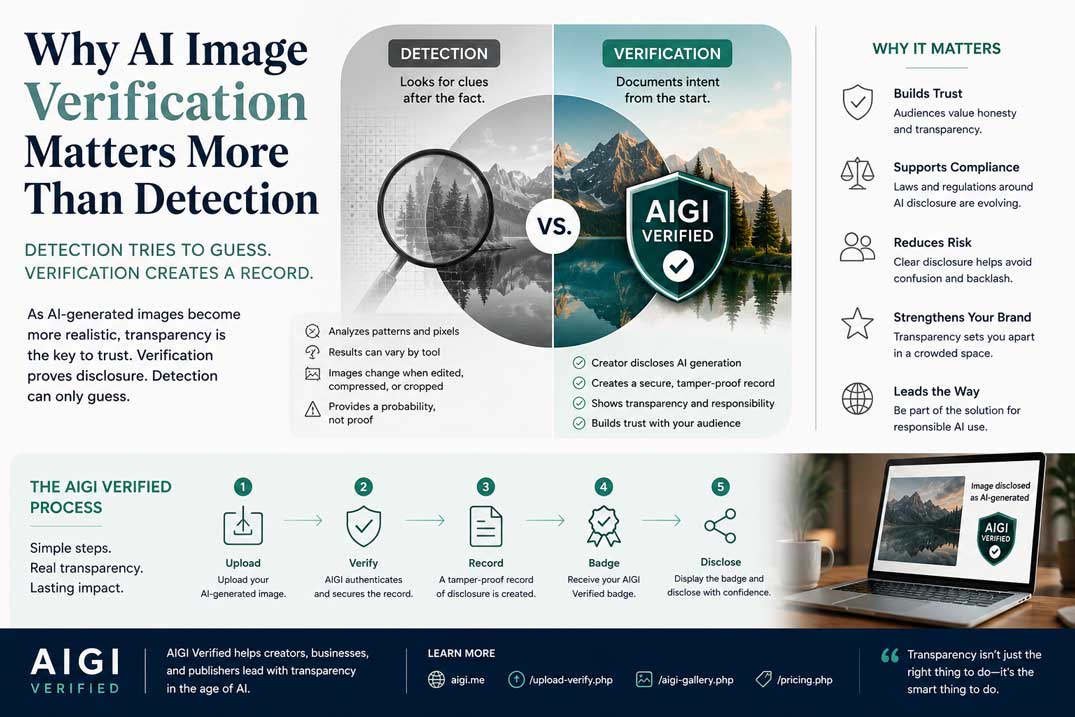
- Create or upload an AI-generated image.
- Verify the image through AIGI.
- Create an AIGI Verified record.
- Display the verification badge with the image.
- Give viewers a clear way to understand the disclosure.
Instead of relying only on a detection tool, creators can take responsibility from the start.
That is a stronger message.
You can also view examples in the AIGI Verified Image Gallery.
Who Should Use AI Image Verification?
AI image verification can help anyone who creates or publishes AI-generated images.
For example, a small business may use AI images in blog posts. A marketing company may create campaign graphics. A real estate brand may use AI visuals for concept images. A creator may post AI artwork online.
In each case, verification helps show that the creator is not trying to mislead anyone.
Instead, the creator is choosing transparency.
That choice matters more as AI images become harder to recognize by sight alone.
AI Image Verification and the Future of Content
AI-generated content will continue to grow.
Some images will be used for art. Some will be used for business. Others will be used in education, publishing, advertising, and entertainment.
Therefore, the question is not whether AI images will exist. They already do.
The better question is this:
How will responsible creators disclose AI-generated images in a way people can trust?
AIGI was built around that question.
We believe the future of AI content should include clear disclosure, simple verification, and better trust between creators and audiences.
Final Thoughts
AI image detection and AI image verification both have a place.
However, they are not the same.
Detection tries to identify AI after the image exists. Verification helps document disclosure from the creator.
That is why AI image verification matters.
As AI-generated content continues to grow, AI image verification offers a practical path toward transparency and trust.
It gives creators a practical way to be honest. It gives viewers a clearer signal. Most importantly, it helps build trust in a world where AI-generated images are becoming part of everyday life.
Detection may estimate. Verification demonstrates intent.
To start verifying your own AI-generated images, visit the AIGI Verified upload page or review the AIGI pricing options.
Helpful Resources
Frequently Asked Questions
What is AI image verification?
AI image verification is the process of creating a record that shows a creator disclosed an image as AI-generated.
Is AI image verification the same as AI image detection?
No. Detection tries to guess whether an image was made with AI. Verification documents that the creator disclosed the image as AI-generated.
Why does AI image disclosure matter?
AI image disclosure helps viewers understand when artificial intelligence played a role in creating an image. It can also help creators build trust.
Who should verify AI-generated images?
Artists, marketers, businesses, publishers, bloggers, and agencies can use AI image verification when they want to disclose AI-generated images clearly.